Faceted navigation is one of the most powerful features for large websites, especially ecommerce and content heavy platforms. When implemented correctly, it improves discoverability, usability, and conversions. When handled poorly, it can destroy crawl budgets, create duplicate content, and dilute rankings. This guide explains what faceted navigation is, how it works, and the best way to do faceted navigation for SEO without compromising user experience.
What Is Faceted Navigation
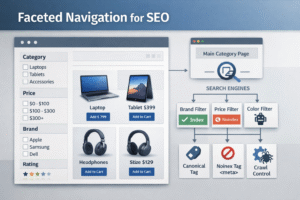
Faceted navigation is a filtering system that allows users to refine results based on multiple attributes called facets. These facets may include price, color, brand, size, category, availability, or ratings. Each selection updates the result set dynamically, helping users find exactly what they want faster.
From an SEO perspective, faceted navigation creates multiple URL combinations for the same base category. This is why faceted navigation SEO requires careful planning. Without control, search engines may crawl thousands of low value URLs that provide no unique benefit.
Common examples of faceted navigation include ecommerce filters, real estate search options, job boards, and large blog archives.
How Faceted Navigation Impacts SEO
Faceted navigation SEO can be both an asset and a liability. Search engines treat each filtered URL as a unique page unless instructed otherwise. This often leads to duplicate content, index bloat, crawl inefficiency, and keyword cannibalization.
However, when optimized properly, faceted search SEO can unlock high intent keyword opportunities and improve category level rankings. The key is deciding which facets should be indexable and which should be restricted.
SEO faceted navigation succeeds when search demand and crawl control are balanced. User driven filters must serve people first while technical rules guide search engines correctly.
Faceted Navigation UX Versus SEO Balance
One of the biggest mistakes websites make is prioritizing SEO over faceted navigation UX or vice versa. A strong faceted navigation system supports both.
From a UX perspective, users expect instant filtering, clear selections, and easy reset options. From an SEO perspective, not every filter combination deserves indexation.
The best way to do faceted navigation is to allow users full filtering freedom while controlling crawl behavior behind the scenes using technical SEO signals. This ensures usability remains intact while search engines focus only on valuable pages.
Faceted Navigation Best Practices for SEO
Implementing faceted navigation best practices is essential for scalability and performance.
First, identify valuable facets. Filters that align with real search intent such as brand, category, or product type may deserve indexable URLs. Facets like color, size, or sorting rarely add SEO value and should usually be blocked.
Second, control URL parameters using canonical tags. Canonicalization ensures that filtered pages point back to the main category or approved facet version. This prevents duplicate content issues.
Third, use noindex strategically. Low value filter combinations should exist for users but remain excluded from the index.
Fourth, manage crawl behavior via robots rules and parameter handling. Search engines should not waste crawl budget on infinite filter paths.
Fifth, create static landing pages for high value facet combinations. These pages can be optimized with unique content, headings, and internal links.
Faceted Search Best Practices for Index Control
Faceted search best practices focus on limiting unnecessary crawling while preserving discoverability.
Avoid indexable URLs for sorting options like price high to low or newest first. These variations provide no standalone value.
Ensure internal linking points only to approved indexable pages. Faceted URLs should not receive uncontrolled link equity.
Maintain clean URL structures. Human readable URLs perform better for both users and search engines.
Monitor indexed pages regularly. Sudden index growth often indicates faceted navigation misconfiguration.
By following these faceted search best practices, websites maintain a healthy index and consistent rankings.
Faceted Navigation Examples That Work
Successful faceted navigation examples usually share a few traits. They separate UX logic from SEO logic, allow deep filtering without indexing everything, and invest in curated facet pages.
Large ecommerce sites often allow users to apply multiple filters while only indexing category and brand based combinations. Content platforms may expose topic filters but restrict pagination and sorting.
These examples show that faceted navigation does not need to be fully open to search engines to perform well.
Faceted Search Engine Considerations
Search engines aim to understand user intent, not infinite URL combinations. A faceted search engine approach that aligns with search behavior will always outperform uncontrolled indexing.
Structured data, clear internal linking, and strong canonical signals help search engines interpret facet relationships correctly. This improves relevance and prevents ranking dilution.
The goal is not to index everything but to index what matters.
Final Thoughts on SEO Faceted Navigation
Faceted navigation is not inherently bad for SEO. Poor implementation is the real problem. When executed strategically, faceted navigation SEO enhances visibility, improves conversions, and supports long term growth.
The best way to do faceted navigation is to prioritize users while guiding search engines with precision. Clear index rules, thoughtful UX design, and continuous monitoring turn faceted navigation from a risk into a competitive advantage.
If your site relies on filters, faceted search, or large product catalogs, mastering faceted navigation best practices is no longer optional. It is a foundational requirement for scalable SEO success.